The Hauraki Gulf Marine Park is under increasing pressure. As fish stocks decline and new management measures are introduced, public debate has intensified. Social media often reflects a deep-seated frustration, frequently directed at commercial operations for the scale of their extraction, or at customary fishing due to a perceived lack of fairness.
While customary and recreational catches are not tracked with the same precision as commercial fishing, the allowances set by the Minister of Oceans and Fisheries provide a baseline for comparing the impact of each sector. Here I examine those allowances for key inshore species.


The commercial sector is permitted to take 74% or six times more fish than recreational fishers and 30 times more than customary fishers. Customary fishing averages 6% of the total take of each species and by weight is 16% of the total recreational catch or 2% of the total allowable catch. This is because customary and recreational fishers take relatively few mackerel.
12% of the total ecological impact of fishing falls under “Other Mortality.” This category represents nearly 1,000 tonnes of fish lost to poaching or incidental death (such as injuries from fishing gear). A high percentage in this category suggests the fish population has either a significant poaching issue or that current fishing methods are causing unnecessary waste, both are a significant management challenge.
Customary fishing impact on High Protection Areas (HPAs)
The experimental HPAs will allow for continued customary fishing while excluding commercial and recreational activity. Using Tāmure / Snapper as a case study, we can model three scenarios for customary take.
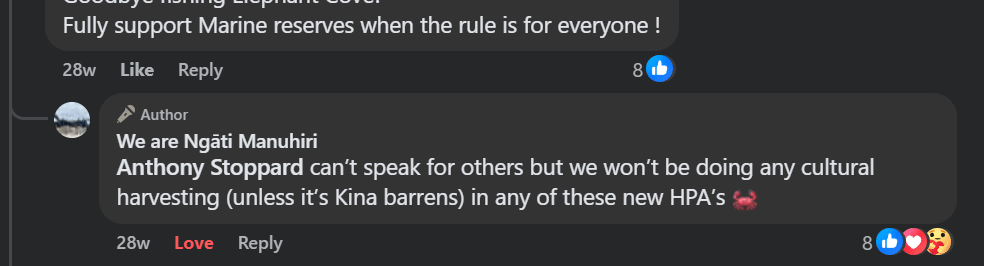
- Scenario A: Voluntary Conservation. The Ngāti Manuhiri Settlement Trust has publicly signalled a preference for non-extractive practices within these zones. If customary fishers choose to bypass the HPAs to allow large breeding fish to reseed the surrounding waters, it will result in an optimal biodiversity outcome for the entire Gulf. Mana whenua have reinforced this by partnering with the NEXT Foundation, the Department of Conservation, and the University of Auckland in a $20 million kelp regeneration programme. This support for active restoration helps cement the view that the HPAs are for healing rather than harvest, making Scenario A the most probable outcome in the short term.
- Scenario B: Even Geographic Distribution. To understand the potential impact, we must first correctly scale these areas. While the HPAs cover 6% of the Hauraki Gulf Marine Park, they represent only 0.35% of the total SNA 1 management region (241,000 km2). If the total 50-tonne customary allowance for SNA 1 were spread evenly across its entire territory, the impact on the HPAs would be negligible. Because the HPAs make up only 0.35% of the area, the statistically “even” take would be just 173 kg per year across all HPAs—roughly 14 fish (at 1kg each) per protection area.
- Scenario C: Concentration of Effort. The risk to the HPAs arises if fishing effort becomes concentrated. Protected areas naturally attract higher fish densities, making them more efficient places to harvest fish for cultural requirements, such as a tangi / funeral. If just 50% of the total customary snapper allowance was harvested from within these small zones, it would result in the removal of 25 tonnes (approximately 25,000 fish) annually. That’s 25,000 1 kg ‘pannies’ or about 2,000 fish per HPA. This level of concentration could undermine the ecological goals of the HPAs.
The legislative framework originally included “Biodiversity Objectives” that would have allowed for limits on customary take within these areas to protect ecosystem health. These protections were removed by the coalition Government at the last minute, specifically by Ministers Shane Jones and Tama Potaka.
Consequently, the ecological success of these areas (relative to the surrounding Gulf) depends on the management of the voluntarily reported customary permits. If the take remains distributed or follows a conservation-led approach (Scenarios A or B), the impact is minimal. However, without the original biodiversity safeguards, the risk of concentrated effort (Scenario C) remains a critical factor for the future of the Gulf and threatens to undermine a $20 million restoration programme.